How Towner Helped Resolve a Mitel E911 Calling Issue at a Missouri Healthcare Clinic
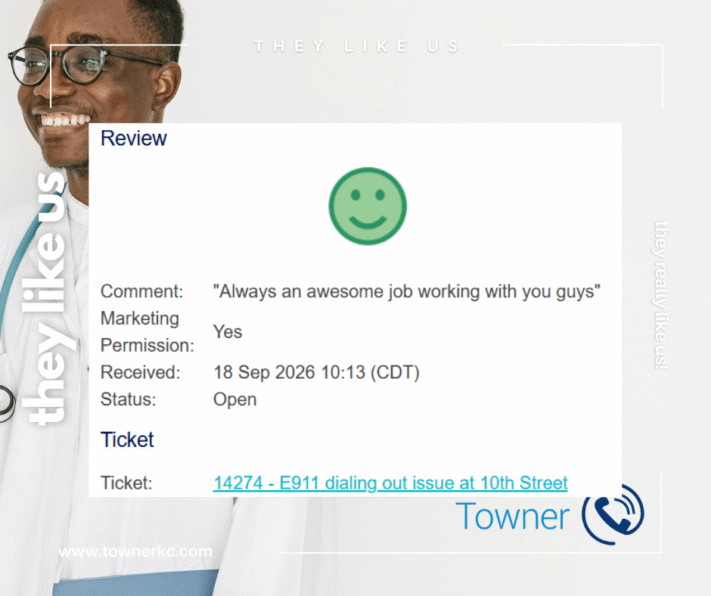
What The Customer Said
“Always an awesome job working with you guys.”
What the Customer Needed
A Central Missouri healthcare organization discovered an unusual—and important—problem at one of its clinic locations.
The phones worked.
Local calls worked. Long-distance calls worked. Incoming calls worked.
But when the clinic attempted to dial 911 from its Mitel business phone system, the call returned a “service unavailable” message.
That’s not the kind of phone-system issue you put on next week’s to-do list.
Towner’s service team worked with the customer’s IT staff to investigate how emergency calls were being handled at the clinic, review the Mitel configuration and systematically test the call routing.
The result wasn’t simply getting a 911 call to connect. It was making sure the clinic’s emergency calling configuration worked as intended.
Key Takeaways From This Customer Support Story
Customer Challenge
A healthcare clinic in Sedalia, Missouri could make normal inbound and outbound calls, but users at the location were unable to successfully place an outbound 911 call through the business phone system.
Root Cause Identified
The investigation centered on how the clinic had been configured within the Mitel system, including its user groups and the rules controlling outbound emergency-call routing.
Towner found that the clinic needed the appropriate user-group and calling configuration so its phones could follow the intended emergency-calling path.
Solution Implemented
Towner worked with the customer’s IT team while the clinic’s users were placed into the appropriate group and the emergency-calling configuration was reviewed.
Rather than assuming the configuration worked, the troubleshooting process included controlled testing of different types of outbound calls and verification of how 911 calls should be handled.
Business Outcome
The customer confirmed that 911 calls from the clinic were working correctly. The remaining step was updating the clinic’s street-address information with the appropriate outside provider/emergency-services records.
Why This Matters
E911 isn’t just another calling feature.
For organizations with multiple offices, clinics, campuses or facilities, a phone being able to make ordinary outbound calls does not necessarily prove that emergency calling is configured correctly.
The emergency call has to work—and the information associated with that call matters too.
Quick Answer
Quick Answer: Why Can a Business Phone Make Regular Calls but Not Call 911?
A business phone system can successfully make local and long-distance calls while still having a problem with 911 calling because emergency calls may rely on different routing rules, trunks, user or location configuration, caller identification and emergency-location information.
In a Mitel environment, troubleshooting an E911 issue may require reviewing several parts of the calling configuration rather than simply checking whether the phone has outside-line access.
That’s exactly what happened in this case: ordinary calling worked while emergency calling required additional investigation.
The Story Behind the Support Request: When Every Call Works Except 911
From the user’s perspective, the problem looked straightforward.
A phone at the clinic couldn’t call 911.
Behind that symptom was a much more complicated question:
Where was the Mitel system actually trying to send the emergency call?
The healthcare organization had recently made changes involving telecommunications service at the clinic. But the customer noted that the 911 problem had existed even before that change. A phone connected directly to the carrier equipment could make and receive calls, while attempting to reach 911 through the business phone system resulted in the unavailable message.
That distinction mattered.
It suggested that simply blaming the carrier change wouldn’t answer the question.
The troubleshooting needed to follow the call through the business communications environment.
Reviewing the Mitel E911 Configuration
The customer’s IT team had already begun investigating and noticed something important: the clinic did not appear to have the same user-group configuration associated with it as other locations.
Towner reviewed the existing Mitel setup and began mapping out how emergency calls from that clinic should be handled.
That included looking at:
- the clinic’s user-group configuration;
- outbound calling rules;
- the available trunks;
- which route should handle a 911 call; and
- how other outbound calls should be handled.
Towner then established a dedicated test user rather than making unverified changes across production phones.
That was intentional.
When you’re troubleshooting a business-critical phone system—especially emergency calling—the goal isn’t to change everything until something starts working.
The goal is to isolate the problem, test deliberately and understand what each change actually does.
Testing More Than the 911 Call
One of the most important parts of this support case was the testing process.
Towner didn’t simply make a configuration change and ask, “Does 911 work now?”
The team established a test extension and instructed the customer to test multiple types of calls, including toll-free, local and long-distance calls before performing the 911 test.
Why?
Because fixing emergency-call routing shouldn’t accidentally break ordinary business calling.
And getting a 911 call to connect isn’t the only thing that matters.
During the emergency-call test, the customer was instructed to verify two critical pieces of information with the 911 center:
What address does the emergency center show for the call?
What callback number does the emergency center see?
The testing process also included confirming callback behavior.
That distinction is especially important for organizations operating from multiple physical locations.
Why E911 Location Information Matters
When someone calls 911 from a traditional residential line, the relationship between a phone number and a physical location can appear simple.
Business communications environments can be very different.
Organizations may have multiple offices, centralized phone systems, SIP trunks, dedicated circuits, remote users and different groups of phones sharing communications infrastructure.
That means the physical location of the person placing an emergency call and the way the phone system routes that call need to be considered together.
During this case, Towner specifically discussed the relationship between the clinic’s emergency calling number, the carrier, the emergency center and the physical street address associated with the location.
For a multi-location organization, “the call connected” should not be the end of the verification process.
The organization also needs to understand what location and callback information is associated with that call.
Resolving the Mitel 911 Calling Issue
As troubleshooting continued, the customer’s IT team was also working inside the Mitel environment.
The clinic’s users were ultimately moved into the appropriate TSC user group, and Towner reviewed the resulting configuration rather than leaving overlapping test settings in place.
The customer then confirmed that 911 calls from the clinic were working correctly.
Towner removed the temporary user group created during testing and confirmed that the test extension had already been moved into the new production group.
The customer’s remaining task was coordinating the correct street-address information with the appropriate external provider/emergency-services records.
That closed the immediate support issue—but it also surfaced a bigger conversation.
What This E911 Issue Revealed About Multi-Location Phone Systems
The interesting part of this service ticket isn’t simply that Towner helped get 911 calling working.
It’s what the problem exposed.
When organizations operate multiple locations on a shared business communications environment, emergency calling needs to be treated as part of the system design—not just another dial-plan entry.
Adding a clinic, moving phones, changing carriers or modifying how locations connect to the phone system can create dependencies that aren’t obvious during an ordinary test call.
A user may be able to:
make an internal call, receive an outside call, dial a local number, and make a long-distance call, while an emergency call follows a different path.
That’s why “the phones work” and “E911 works correctly” are not necessarily the same statement.
For healthcare organizations, schools, government facilities and other multi-location operations, that distinction deserves attention.
Common Mitel E911 Problems Businesses Should Watch For
A 911 calling problem won’t always look exactly like this one. Depending on the Mitel environment, carrier configuration and organization, troubleshooting may involve questions such as:
911 Calls Won’t Complete
Normal outbound calling works, but dialing 911 produces an error or fails to complete.
The Wrong Location Is Associated With the Call
The emergency call connects, but the location information associated with the calling number may not reflect the user’s actual physical location.
The Wrong Callback Number Is Presented
Emergency personnel need a usable callback path if the original call disconnects.
A New Location Was Added to an Existing Phone System
New offices, clinics and facilities may require more than adding phones or extensions. Emergency-calling requirements should be considered as part of the location’s communications configuration.
Phones Were Moved Between Locations
With modern business communications systems, a phone or user can sometimes move much more easily than the emergency-location information associated with that user.
Carrier or Trunk Changes Were Made
Changes to SIP services, circuits or outbound routing can affect how calls leave the business phone system and should trigger appropriate testing.
The exact troubleshooting process depends on the environment. That’s why E911 problems should be diagnosed based on the actual phone-system and carrier configuration rather than a generic checklist.
E911 Testing Should Be Part of Business Phone System Changes
There’s a broader lesson here.
When an organization changes how a location connects to its phone system, adds a facility, moves users or changes telecommunications providers, emergency calling deserves its own validation process.
A good test should answer more than:
Can I dial 911?
It should help verify:
- Does the call complete correctly?
- What number is presented?
- What location information is associated with that call?
- Can the emergency center call back?
- Are normal outbound calls still routing correctly?
The exact requirements and testing procedures will depend on the organization’s communications environment and applicable emergency-calling requirements.
But assuming E911 works because ordinary calls work is not a test.
Mitel Support for Business-Critical Communications
Business phone support isn’t always about a dead handset or a voicemail password.
Sometimes the phone appears perfectly normal until someone tries to use a function that matters far more than most.
That’s why Towner’s Mitel support team looks beyond the visible symptom.
For this Central Missouri healthcare organization, that meant working alongside the customer’s IT team, reviewing the existing Mitel configuration, testing different call paths and helping verify that emergency calling from the clinic was functioning correctly.
The technology may be complicated.
The outcome shouldn’t be:
When someone needs to call 911, the phone needs to work.
Related Mitel Phone System Issues
Organizations experiencing a Mitel issue may also encounter:
- Mitel call routing problems
- Direct dial number conflicts
- Incorrect extension assignments
- Call forwarding configuration errors
- Voicemail routing issues
- Business phone system administration challenges
- Unified communications routing concerns
Supporting Business Communications Across the Midwest and Nationwide
From schools and local governments to healthcare providers and growing businesses, organizations across Kansas, Missouri, Wisconsin, Minnesota, the broader Midwest, and nationwide depend on reliable communications systems. When routing issues impact productivity, experienced telecommunications support can help restore functionality and reduce disruption.
Frequently Asked Questions About Mitel E911 Support
What can cause 911 calling to fail on a Mitel phone system?
The cause depends on the system and carrier environment. Potential areas to investigate can include user or location configuration, outbound calling rules, trunk routing, emergency calling configuration and the relationship between the calling number and emergency-location information.
A proper diagnosis should follow the actual call path rather than assuming that normal outbound calling proves 911 is configured correctly.
What should a business verify when testing E911?
Testing should be appropriate for the organization’s specific system and procedures. In this case, Towner’s troubleshooting included checking whether the emergency call completed and asking the emergency center to verify the address and callback number associated with the test call.
Organizations should coordinate emergency-call testing appropriately rather than placing unnecessary test calls to 911.
Should E911 be tested after making changes to a business phone system?
Emergency calling should be considered whenever changes could affect users, locations, carriers, trunks or outbound call routing.
The appropriate validation process depends on the system and the nature of the change.
Can a business phone make normal calls but still have an E911 problem?
Yes. That is exactly what occurred in this support case.
The clinic could successfully make ordinary calls while its 911 call returned a service-unavailable message.
Emergency calls can be handled differently from ordinary outbound calls, which is why they need to be tested independently.
Why does location information matter for business E911?
Businesses can have employees and phones across multiple buildings or locations while sharing portions of the same communications infrastructure.
Emergency responders need accurate information associated with an emergency call. For multi-location organizations, emergency-calling configuration therefore needs to account for where calls originate, not simply whether they can reach 911.
Does Towner provide Mitel phone system support in Missouri?
Yes. Towner provides Mitel business phone system support for organizations in Missouri, including troubleshooting, configuration and ongoing support for business-critical communications environments.