
What Makes Data Center Cabling Different From Traditional Structured Cabling?

Traditional structured cabling supports connectivity across offices, schools, healthcare facilities, warehouses, and commercial buildings every day. But data center environments operate under an entirely different set of operational expectations.
The infrastructure inside a data center is expected to support continuous uptime, higher density, greater scalability, and mission-critical performance. That changes how cabling systems are designed, installed, documented, and maintained.
For general contractors, enterprise buyers, and infrastructure stakeholders, understanding these differences matters because the planning requirements inside a data center are fundamentally different from a standard commercial low-voltage deployment.
Why Data Center Cabling Requires a Different Approach
Data center infrastructure supports:
- server environments
- storage systems
- network cores
- cloud infrastructure
- disaster recovery systems
- high-speed backbone connectivity
- enterprise applications
- uptime-sensitive operations
That changes the operational expectations dramatically.
In commercial office environments, temporary downtime may be disruptive.
Inside a data center, downtime can affect business continuity, cloud services, financial systems, communications infrastructure, and operational performance across entire organizations.
This is why structured cabling for data centers is often treated as mission-critical infrastructure rather than standard low-voltage construction.
Uptime Changes Everything
Infrastructure decisions are heavily influenced by minimizing operational risk during:
- maintenance
- upgrades
- migrations
- troubleshooting
- equipment refreshes
- phased expansions
Redundancy and Failover Planning
Data center environments commonly include:
- redundant fiber pathways
- A/B network architectures
- diverse routing paths
- failover systems
- secondary backbone infrastructure
- redundant distribution areas
These systems are designed to reduce single points of failure and improve operational resiliency.
Unlike traditional office deployments, simplicity is not always the primary goal. Resiliency and scalability often drive infrastructure decisions instead.
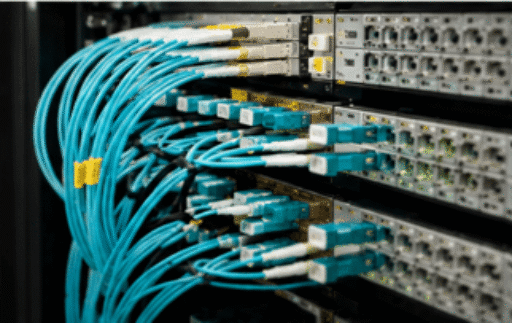
Density Is Significantly Higher in Data Centers
Data centers centralize enormous amounts of connectivity inside concentrated rack environments.
A traditional office may distribute connectivity across hundreds of endpoints throughout a building. A data center may concentrate thousands of fiber and copper connections within a single row of cabinets.
Rack Density and Cable Volume
Modern enterprise and hyperscale environments often contain:
- high-count fiber trunks
- dense patching fields
- top-of-rack switching
- end-of-row architectures
- spine-leaf network designs
- large-scale server clusters
Without careful planning, cable congestion can quickly create operational problems.
Poor cable management impacts:
- airflow
- maintenance access
- troubleshooting efficiency
- scalability
- long-term serviceability
In mission-critical environments, cable management becomes an operational necessity rather than a cosmetic preference.
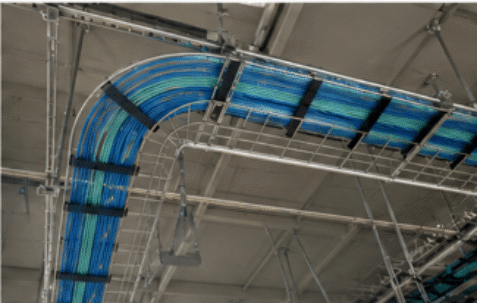
Cable Pathway Planning Is More Complex
Data center pathway planning typically requires:
- overhead ladder rack systems
- underfloor routing
- segregated pathways
- bend radius protection
- growth capacity planning
- coordinated routing strategies
Infrastructure teams often need to think years ahead because future expansion is expected from the beginning.
Fiber Backbone Infrastructure Plays a Larger Role
Fiber optic infrastructure is central to most modern data center environments.
Traditional commercial office environments still rely heavily on copper horizontal cabling. Data centers depend extensively on fiber backbone infrastructure to support:
- high-speed switching
- storage connectivity
- inter-room backbone transport
- cloud infrastructure
- scalable enterprise networking
- hyperscale bandwidth requirements
High-Speed Infrastructure Requirements
Modern data centers are increasingly deploying infrastructure capable of supporting:
- 40G
- 100G
- 400G
- future high-bandwidth standards
That changes how systems are designed.
Infrastructure planning must account for:
- connector standards
- cassette architectures
- trunk configurations
- polarity management
- testing standards
- future migration strategies
These considerations are far more complex than traditional office network deployments.
Airflow and Thermal Management Matter
One of the lesser-understood differences between standard structured cabling and data center cabling is how closely infrastructure affects cooling efficiency.
Poor cable routing can:
- obstruct airflow
- increase heat retention
- reduce cooling efficiency
- complicate maintenance
- interfere with containment systems
As rack density increases, airflow planning becomes increasingly important.
Hot Aisle and Cold Aisle Design
Many enterprise environments use hot aisle/cold aisle configurations to improve thermal management and cooling efficiency.
Cabling systems must support these layouts without:
- blocking airflow
- creating congestion
- interfering with containment systems
- limiting technician accessibility
This requires coordination between infrastructure teams, facilities personnel, and mechanical systems.

Documentation Standards Are More Demanding
Data center environments evolve continuously.
Without accurate documentation, operational risk increases significantly.
Documentation standards often include:
- detailed labeling systems
- rack elevations
- pathway mapping
- fiber strand tracking
- port documentation
- test results
- lifecycle records
This information becomes critical during:
- troubleshooting
- expansion phases
- equipment replacements
- migrations
- audits
- maintenance activities
Managing Phased Deployments
Many enterprise and hyperscale deployments occur in phases over long periods of time.
That creates additional complexity when:
- multiple contractors are involved
- systems remain operational during construction
- infrastructure expands incrementally
- environments evolve over several years
Consistent documentation helps maintain continuity across deployment phases.

Hyperscale Environments Require Operational Awareness
Large-scale infrastructure projects involve coordination between:
- facilities teams
- network engineers
- electrical contractors
- mechanical contractors
- security teams
- commissioning teams
- general contractors
- infrastructure specialists
Infrastructure installers must understand how their work affects broader operational systems.
That level of coordination is rarely required in standard commercial office environments.
Infrastructure Built for Future Expansion
Hyperscale and enterprise environments are designed with growth in mind.
Infrastructure planning frequently includes:
- reserved pathway space
- additional rack capacity
- modular deployment strategies
- scalable fiber backbone systems
- long-term infrastructure forecasting
The infrastructure must support not only today’s requirements, but future operational growth as well.
Why Experience Matters in Mission-Critical Infrastructure
Data center infrastructure projects require more than installation capability.
They require:
- operational discipline
- coordination experience
- documentation consistency
- planning awareness
- scalability expertise
- familiarity with uptime-sensitive environments
Organizations operating inside enterprise and mission-critical environments often prioritize infrastructure partners who understand:
- phased deployments
- fiber-intensive environments
- high-density infrastructure
- redundancy planning
- operational risk management
- enterprise infrastructure standards
Towner has supported structured cabling, fiber optic infrastructure, and enterprise communications projects across Missouri, Kansas, and the broader Midwest, including work inside large-scale and mission-critical environments. Many hyperscale projects operate under NDA, but the operational expectations remain consistent: infrastructure must be carefully planned, thoroughly documented, scalable, and operationally aware.
Serving clients across Missouri, Kansas, and the broader Midwest. Virtual support available nationwide.
Why Data Center Cabling Requires Specialized Infrastructure Planning
Traditional structured cabling and data center cabling may appear similar on the surface, but the operational requirements behind them are fundamentally different.
Data center environments require:
- higher density infrastructure
- greater redundancy
- advanced fiber backbone planning
- airflow-aware routing
- strict documentation standards
- phased deployment coordination
- infrastructure designed for scalability
Most importantly, they require a different level of operational awareness.
As enterprise infrastructure continues evolving, organizations increasingly need infrastructure partners who understand not only how to install cabling systems, but how those systems function inside uptime-sensitive, mission-critical environments.
Data Center Cabling FAQs
What is data center cabling?
Data center cabling refers to the structured fiber and copper infrastructure used to support servers, switches, storage systems, and enterprise network connectivity inside data center environments.
Why is fiber optic infrastructure important in data centers?
Fiber infrastructure supports the high-speed backbone connectivity required for modern enterprise and hyperscale environments, helping support scalability and increasing bandwidth demands.
How is data center cabling different from office structured cabling?
Data center cabling requires greater redundancy, higher density, advanced fiber backbone infrastructure, stricter documentation standards, and more careful airflow planning than standard office environments.
Why does cable management matter in data centers?
Proper cable management improves airflow, simplifies maintenance, supports scalability, and helps reduce operational risk inside high-density environments.