It is essential for businesses to consider a Cloud Communication Strategy Upgrade in today’s fast-paced digital world.
‘s time to get strategic! You do it in every other aspect of your business, why aren’t you being strategic when it comes to managing your technology. And by the way a huge part of your technology is your phone and communication solutions.
Lean into the idea of LEVERAGE
Tons of people think they know technology, tons of people in reality DON’T! Wrap your brain around this… “a bird in the hand is worth two in the bush.” We’re willing to bet when you stop and engage experts to analyze the technology you have in place, you’ll find that the equipment you already have could have the capabilities to do really cool things you want it to, but haven’t set it up for. Think about the fact that humans only use 10% or their brain’s capacity OR you know that your smart phone has way more features and capabilities than you know how to use. IT’S THE SAME THING HERE!
So in our first light bulb moment, we learned that before we let our current vendor or our new vendor talk us into a brand new system (a rip and replace as we call it) we should first completely vet what our current system can do. Would upgrades and or updates be the solution to our needs?
And here’s a hint, if you aren’t staying current on upgrades either because you want to save money or your vendor isn’t helping keep you current, you’re going to end up spending much more money in the long run.
Know the TCO
You need to be aware of your Total Cost of Ownership. This one is huge. It’s the difference between an operating expense and a capital expense. Cloud systems do come with a smaller upfront costs by nature, however you might be really shocked when you sit down and do the math. There are indeed fees that will pop up and are unpredictable and unavoidable like usage tax, rental fees etc.
This Mitel MiVoice Business customer is configured for 100 employees. Take a look at the total cost comparison
Having already paid for the system, you’ve eliminated the cost for the hardware and software that runs it. You own it. But the simple addition of MiCollab to facilitate chat and collaboration, you’ve provided your team with features and functions you would get from switching to a new cloud vendor. Most importantly, the updates and upgrades needed to keep your system operating at peak efficiency at all times are covered by the Mitel Software Assurance plan. So, over a one-year period, the
TCO for your on-premises system would be $37,000 and over three years the TCO would be $81,000.
STRATEGIC wins the race
Eventually, all businesses will end up with some form of a cloud-based solution. However, your communications system requirements should be dictated by how the system is expected to contribute to your daily business operation and your communications strategy should evolve with your business needs
If you can address all your requirements by leveraging your existing on-premises equipment, then that’s probably what you should be thinking about before you consider cloud migration. But chances are, there are incremental updates and upgrades you should be making today that will keep your system as flexible as possible, ready to capture opportunities when they arise and enable you to better support the needs of today’s workforce.
LEVERAGE Towner
Towner makes it easy for you to think strategically about how best to leverage your communications solutions.
Our warranty programs are build to keep your current and relevant. Through our ongoing system evaluations and health checks, we always know where you stand if you hold a warranty with us.
Then when it truly is time to move to the cloud, our team as well as your team know what features and functionality are needed to make the transition as smooth and cost effective as possible
It’s all about the bottom-line when it comes to running a successful business. How and where to spend dollars is an ongoing struggle.
As the puller of the purse strings, CFOs must have a critical eye when they determine expenditures and every year might bring with it a host of changes and market conditions that impact those decisions. Historically, investments in a companies IT, CFOs get really excited about capital expenditures or CapEx, so the company can take advantage of amortization and depreciation. But times are changing and there is a roaring debate, that operating expenditures (OpEx) are now the better way to put money to work.
OpEx In IT Spending Gets Popular Than CapEx
The business world is packed full of hard costs that demand massive, upfront investments and have to be included in yearly budget figures (CapEx). These are monies that have the ability to be planned for in advance. But as we all know using our ESP to predict tomorrow can be hairy. We know our plan A isn’t workable without a plan B. More often than not what has been planned for doesn’t totally align with what we actually need. And as we learned in 2020 technology moves at lightning speed if need be, and can often be unpredictable. So our tech spend has become as predictable as the Midwest weather.
Y’all we got the CLOUD! The way we consume and house our technology today, means that we need less physical real estate, and boots on the ground. Contracts have turned into month-to-month subscription based platforms, and switching vendors, carriers, etc has become less cumbersome. This frees up a ridiculous amount of cash, and it also means that little guys who once couldn’t afford to play are now in the major leagues.
Other inherent pains with CapEx technology:
Huge cash requirement
Guesswork to estimate future capacity needs for static hardware/software
Painstakingly long processes to estimate budget and get it approved
Once the investment is made, your is stuck with it – despite technology advancements or changes in company growth
Now lets contrast this with Operating Expense. These types of “investments” are generally day-to-day costs of doing business. Usually they are more stable and more predictable.
Here’s why we’re loving Technology as an OpEx:
Pay only for the capacity you need, with the ability to scale up or down
Easy and speedy to get into that budget
Free up the huge cash investments for other areas of the biz
No borrowing needed
Nice easy cash flow
No matter how you and your leadership want to grow your company, be sure that your vendors are flexible so that your company can grow and flex with the ever changing business landscape that we’re in!
How integrating multichannel cloud business
communications and applications drives innovation
and productivity across the enterprise.
January 2015 marked 100 years since the first cross-country telephone call. “Mr. Watson, are you there? Do you hear me?” This landmark event spawned an era in which analog voice calls became the primary communication tool for business. But times have changed; and although the telephone is still critical for building relationships, business communications now rely on a mix of voice plus everything from email to group chat. Additionally, knowledge workers have moved beyond simple desk phones to embrace mobile devices and softphones, as well as new desk phones that incorporate cutting-edge voice and video technology.
Plus, businesses haven’t just changed the way they communicate; they have also changed the way they work. This includes organizing workflows around business apps, including customer relationship management (CRM), human resource management (HRM), and enterprise resource planning (ERP). In recent years, many enterprises have moved these critical systems out of the data center and into the cloud. This includes not only software as a service (SaaS) models such as Salesforce, but also homegrown business applications developed by enterprise IT departments and deployed on public, private, or hybrid clouds.
However, many businesses find themselves struggling with on-premise phone systems that carry forward the limitations of decades-old technology. The result is a huge gap between communications platforms and essential business apps as well as the apps employees increasingly use for multiple modes of communications.
For example, while cloud-based apps, such as Gmail™, Microsoft Office 365™, and Salesforce® provide tremendous costsavings and are vital to greater efficiency and productivity, thus far, these systems have not been integrated with business communications. Communication data remains siloed from business app data, preventing management from having a unified view of the business. And with the exception of email, most modes of communication—such as voice calls, text, voicemail, fax, and online meetings—still require employees to perform tedious, error-prone manual data entry to log a conversation. The data stored in call logs is also typically isolated from other systems. For example, if a sales rep uses a call, text, or web meeting to communicate with a customer, critical information gained by the rep during the conversation can easily be lost or forgotten.
Cloud phone systems, on the other hand, grew up with mobile networks, new internet-based communications tools, and cloud business apps, making them ideally suited to today’s enterprises. This paper discusses how a robust, extensible cloud communications platform—which includes cloud APIs and SDKs for developers—can enable a new era of integrations between business communications and key business processes and workflows.
Seamlessly integrating communications into the new workspace
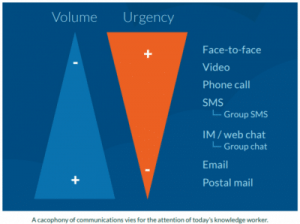
Today’s knowledge workers often use multiple devices—desktops, smartphones, and tablets—to communicate in a dizzying variety of ways, including voice calls, SMS, group SMS, instant messaging, email, and chat. In addition, business apps pile on additional channels of communications with customers, coworkers, and partners.
The constant chatter from all these devices and channels inundates employees. And to make matters worse, the highest volume communications are not necessarily the most urgent.
Matching IT technology with the multimodal way people work today requires a comprehensive enterprise business communications platform. Prebuilt and custom integrations in such a platform not only give employees a workspace with everything in one view, but can also surface the most important and urgent communications in the most appropriate way.
Previously, any company that wanted to create this type of seamless workflow between phone calls or other communication methods and their business applications discovered it was costly, complicated, and often impossible to achieve. This is primarily because of the inability of business apps to connect with closed, single-purpose phone systems. Gaps can also exist between the various apps commonly used by companies and among the various communications tools used by their employees. The advent of truly enterprise-class cloud communications systems now makes it possible to integrate business applications with business communications.
Leveraging cloud PBX for business communications
A cloud communications system overcomes many of the limitations inherent in legacy on-premise PBX systems to deliver greatly improved communications. For example, workers in one location can easily connect with colleagues in other offices using direct transfers and direct extension dialing. Once employees leave a location, calls automatically follow them wherever they go, and they can access voicemail, fax, conferencing, and all other company communications functions as seamlessly as if they were at the office.
A comprehensive cloud communications platform also delivers a range of new features and capabilities—such as a rich collaboration space that includes everything from online meetings to group chat.
Beyond email: group productivity with rich collaborations
As enterprise communications have evolved, the need for rich collaborations among teams, groups, and departments has become an essential capability. Collaboration tools such as audio and video conferencing, web meetings, chat, and SMS on desktop devices or smartphones allow employees to share their ideas and improve office productivity and efficiency, and they allow groups to work together more cohesively.
Empowered chat
As employees bring new forms of communication into the workplace, chat and SMS have become as much a part of a worker’s daily routine as voice calls. Until recently, text-based communications were not supported by enterprise IT departments and were not widely adopted in industries with major concerns regarding data security and compliance. The cloud changes how text-based communications can be supported. Enterprise-grade chat clients and support for SMS are now widely available on desktop and mobile devices. History logs as well as IT administration capabilities give control back to the CIO and help ensure security and compliance.
A variety of chat integrations can empower teams with richer collaboration. For example, advanced features and integrations between the phone system and instant messaging make it easy to escalate a group IM to a conference call. Or, the integration of empowered group chat into the phone system can help users increase productivity with direct access to features such as file sharing, tasks, notes, image annotations, video conferencing, and screen-sharing technology. Team
members also have the ability to assign tasks and integrate group meetings with the calendar.
Users can also link a chat meeting with other cloud services, such as Box, Dropbox™, Google, Evernote®, and JIRA®. This includes the ability to manage file sharing and storage that is relevant to the group collaboration.
Audio conferencing and online meetings
Audio conferencing integrated into a cloud phone system allows employees to connect with colleagues from a single conference bridge. Conference calling also enables mobile and remote workers to easily and cost-effectively work from any location and collaborate as if they were in the office. Online meetings give staff members the flexibility they need to share and work together at any time and from any location. Employees can deliver presentations from a computer, tablet, or smartphone. They can share their screens, web pages, and files from their devices or cloud storage accounts to add context and collaborate more effectively.
The trusted enterprise cloud platform
The RingCentral platform provides best-in-class cloud communications designed to serve today’s modern businesses. It delivers a completely integrated cloud communications solution that includes voice, SMS, fax, collaboration, and other powerful capabilities—with enterprise-grade security and carrier-grade reliability. This platform, which is based on a decade of R&D and is used by more than 350,000 businesses worldwide, also provides significant advantages, such as the ability to scale the phone system and manage it remotely without the need for staff with PBX experience at each business location.
Standard integrations with the most popular business apps
The platform includes prebuilt solutions that integrate the RingCentral Office® cloud phone system with popular cloud services such Microsoft Office 365, G Suite (a suite of tools that includes Gmail and Google Docs™), Salesforce, Zendesk®, and Dropbox.
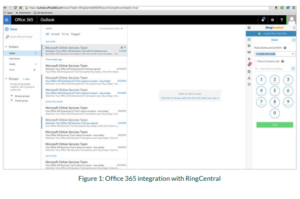
The example in Figure 1 shows how RingCentral created a seamless integration with Office 365. RingCentral for Office 365 users can access a dialer, audio conferencing, Business SMS, and virtually the entire RingCentral Office feature set from within the email interface. Employees can make or receive calls and have text conversations on their mobile devices—all seamlessly. With more and more large organizations using Office 365 as their preferred email solution, this capability creates a natural, intuitive workflow.
With another integration example, RingCentral for Salesforce, Sales teams can make or receive calls, use Business SMS, or initiate a conference call without leaving their familiar work environment. Incoming callers are instantly matched to existing contact records, which are automatically displayed. The sales rep can also take notes while on a call and can choose to save those to the customer’s CRM record.
The first open, self-service cloud communications platform
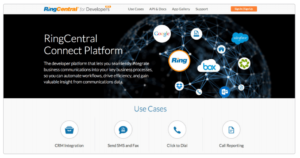
This powerful platform is also open to developers, partners, and customers, allowing businesses to easily integrate robust communications capabilities into key enterprise applications. The RingCentral Connect Platform™ for developers (developer. ringcentral.com) offers a family of cloud APIs with a comprehensive SDK that integrates voice, SMS, and fax communications within important business processes.
With the RingCentral Connect Platform, developers, customers, and ISVs can now access the power of multimodal, realtime communications supported by extensive business logic and customer data management and reporting. This makes it easy for developers to not only enable their applications to send and receive calls and texts, but also to deeply embed communications functionality into the workflow of critical business applications.
For example, the RingCentral Connect Platform provides an SDK, tutorials, and developer support to create robust CTI integrations that seamlessly connect the RingCentral platform with Zoho, Salesforce, and other leading CRMs. The RingCentral Connect Platform also enables IT teams to create customized services that automate workflows, drive efficiency, and improve customer satisfaction. For example, a national locksmith service company connected its CRM and dispatch software with the RingCentral platform. This custom integration makes it possible to dispatch locksmiths via SMS. Customers then receive SMS notices that a locksmith is on the way. The integration includes an immersive custom workflow that connects to back-end business systems, allowing the agent to quickly match the locksmith with the customer.
A future-proofed business communications system
Now, companies can bridge the gap between disparate business systems or between systems and users by integrating this self-service cloud communications offering with any application. In addition, customers and ISV partners can easily create differentiated product offerings by incorporating next-generation communications features.
This is critical for businesses in today’s competitive environment, where the company with the best technology often wins. Looking at the seamless blend of services and communications in offerings such as Uber shows that these types of integrations can even disrupt entire industries. For enterprise IT departments looking to drive competitiveness through technology, the RingCentral platform offers an open path to staying competitive today and in the future.
What developers do with the power and capabilities of the RingCentral platform is limited only by their imaginations. For example…
A taxi or limousine service that uses RingCentral Office for voice dispatch could add automated SMS confirmations (for example, “Your car will arrive in two minutes”) to its custom dispatch software. Or, if a customer needed to meet a limo driver at the airport, the phone system could automatically send a photo of the driver by text or email.
An online electronics retailer could improve both sales and customer satisfaction by integrating a custom CRM system with real-time access to information. For example, a pop-up note based on the incoming caller ID could provide information about the customer’s prior orders and help the associate provide the caller with relevant information.
A medical office could integrate its back-end appointment system with patient contact information and automatically send appointment reminders via text message, and patients could reply to confirm or request a change.
An independent developer could create an integration that enables shoppers to connect with product reviewers. Reviewers wouldn’t even need to be online. They could receive questions via SMS, and their responses could post to the retailer’s website in real time.
Insights from communications metadata in the era of big data
Day-to-day business communications generate an invaluable stream of metadata. However, most of that data remains siloed, unstructured, or unavailable. For example, account managers often use mobile phones to continue working when they leave the office. But because many businesses rely on legacy, on-premise PBX systems, the records of those customer calls can easily be lost. With big data and the ability to derive valuable insights from analyzing that data, this lack of integration with a robust platform results in lost opportunities.
Metrics such as conversion, engagement, and utilization rates are not just important in web-enabled applications but also in real-time communications. IT managers, ISVs, and system integrators understand that these stats can drive intelligent decision making.
The RingCentral platform captures and stores a wealth of valuable data about your company’s or your customers’ communication behaviors (for example, when, where, and with whom they communicated), as well as levels of engagement, utilization, and success. This data even includes the steps that were taken before and after the engagement and which endpoints (desktop, web, mobile, etc.) were used. With RingCentral, application integrations can be easily customized to measure these business analytics and create reports or real-time dashboards.
Summary
Many knowledge workers today live in business apps such as Microsoft Office 365, G Suite, and Salesforce. They also rely on multiple communication apps—on multiple devices—to stay in touch with customers and collaborate with teams. These workers also expect their own devices and apps to integrate smoothly into the company phone system and enterprise business systems. All the while, IT must ensure reliability and security.
It takes a comprehensive enterprise-grade communications platform to satisfy these business needs. RingCentral provides an industry-leading UCaaS platform that offers a full suite of communications tools that are essential for today’s workers. More importantly, RingCentral integrates these tools with many of the most popular cloud apps, giving management a better view into the business and workers a better, more collaborative work environment. A robust developer’s platform also makes it easy for IT teams to create custom integrations and unique new service offerings.
This is the new work environment. From intelligence in the platform that can surface the most urgent messages to automatic dialing from within apps such as Office 365 or Gmail to empowered chat, by offering the strongest foundation for businesses to create new, disruptive service offerings, the RingCentral platform is the leading choice to equip your workforce for the challenges of tomorrow.
About RingCentral
RingCentral, Inc. (NYSE: RNG) is a global provider of cloud unified communications and collaboration solutions. More flexible and cost-effective than legacy on-premise systems, RingCentral empowers today’s mobile and distributed workforces to be connected anywhere and on any device through voice, video, team messaging, collaboration, SMS, conferencing, online meetings, contact center, and fax. RingCentral provides an open platform that integrates with today’s leading business apps while giving customers the flexibility to customize their own workflows. RingCentral is a leader in the 2017 Gartner Magic Quadrant for Unified Communications as a Service Worldwide for the third consecutive year. RingCentral is headquartered in Belmont, Calif.
Arm your business with a Cloud customer experience that blows your competition out of the water and generates the sales and service results you’ve been dreaming of!
Super slick and quick inbound call routing
Towner Communications & RingCentral’s Contact Center intelligently routes calls to your best customer service agents for the most impactful resolution. This delivers the best customer experience with skills-based call routing, leaving your clients smiling!
Best of brand outbound capabilities
Who wants stellar outbound sales connections. No more awkward delays when greeting callers while increasing agent productivity with our capability for multiple, simultaneous predictive calls. Agents are connected at the first hello, paving the way to better outcomes, higher conversion rates, and increased revenues.
Omnichannel routing
Empower agents across all channels—voice and digital—with a single, intuitive agent interface. Communicate with your customers the way they want to on their device of choice and increase customer loyalty and satisfaction.
Workforce management
Optimize agent availability and achieve your goals with efficient and actionable schedules. Powerful forecasts and adherence measurements help you maximize agent availability and minimize agent downtime to reduce costs.
Quality management
Ensure you are getting the best performance from your agents with our agent-centric approach to Quality Management. Features such as call screening, agent self-evaluations, and automated feedback and workflows give your team the tools they need to provide the best possible service.
Real time analytics
RingCentral Contact Center Analytics offer a wide range of customizable, visual ways to make business-critical decisions in real time. With up-to-the-minute data accessed through easily customizable dashboards, you’ll be better equipped to address business issues in your call center as soon as they happen.
Customer surverys
Towner Communications Contact Center supports a wide range of survey methodologies for measuring customer satisfaction. Choose from Net Promoter® Score (NPS) surveys, Customer Effort Scores, general satisfaction ratings, and more.
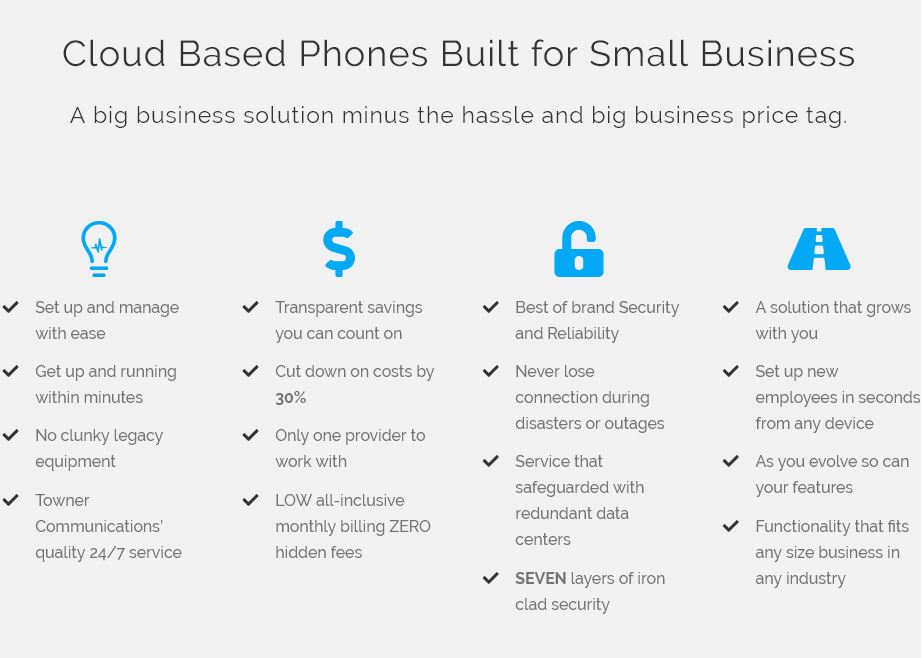
Cloud Based Phone solutions for small business allow you and your team to work exponentially better and far smarter with intuitive team collaboration, and the ability to integrate with nearly every business application on the market.
The cloud based phones are mind blowingly simple to implement and manage through out the life and growth of your small, medium, or enterprise business.
Make sure that your team has the freedom to break out of their inboxes and build stronger relationships with effective real-time messaging, video calling, file sharing, tasks, and more.
Got apps that are mission critical?
Great! There’s 100+ that we seamlessly integrate with!
Positioned furthest in the Leaders Quadrant for completeness of vision and ability to execute
There seem to be plenty of choices for cloud phone solutions that improve business. But what do the experts really say about providers that are truly innovating and actually optimizing the capabilities of a cloud communications system?
Visit RingCentral’s report summary page to see the analysis you need to build a business case and create a vendor short list.
Review market data from the independent market research firm Synergy Research Group and vendor reports from three leading analysts—Gartner, IHS Markit, and Frost & Sullivan. Get objective insights into the top vendors of cloud phone solutions and see how they perform when compared to each other and against traditional on-premises systems.
Towner Communications is here when you’re ready to talk about taking that next oh-so-important step—moving to the cloud with the UCaaS market leader.
The biggest buzz words in business and in our government are CYBER SECURITY and CLOUD. The evolution of the “cloud” has gone from where we’ve stored pdf and pictures to hosting our telecommunications and basically storing our entire business. Critical and sensitive business and personal information is exchanged and stored making it a hacker’s personal heaven. One do non-tech people really understand what “The Cloud” is, and two if you don’t really understand what the cloud is how can you really have piece of mind that you’re safe and protected? Brace yourself, but the easy and unpleasant answer…You are never nor will you ever be 100% safe. Now, hold on to your pants because there are very basic and very key steps that you can take to ensure that your exposures are reduced almost down to nothing. The key is, hire experts and then listen to your experts! Here’s why Towner Communications the Cloud Telecommunications Experts in the Midwest…Yes we can claim that, are telling you to get in the cloud.
Here’s our top 3 reasons we propose Cloud Solutions to almost if not all of the small to medium size partners we consult for.
1. Physical Real estate in their office: Premise telecom solutions can be massive and take up more space in your office than you can give up. The entire concept the cloud is that everything is off site and tucked into a server in a far off land. Use that extra room for your ping pong table, or an extra office.
2. Cost Savings: Unlike on premise solutions, unless you purchase the equipment you’ll be using, there is little to no upfront major cash lay out. Flexible plans mean you can rent the equipment and ALL your telecom services and needs are wrapped into one nice tight little monthly payment.
3. Flexibility: As your business grows so can you’re solution. As you’re business becomes seasonal so can your solution.
These are all great selling points of the cloud and are the apex of what small and medium companies need to grow and stay competitive. HOWEVER please proceed with caution when you’re evaluating a provider!!! You have to ask the right questions and receive the responses that are clear and accurate and fit the culture of your business. Not all carriers are created equal and not all fire sale tactics (like tossing in phones for free) or promising the lowest prices in the industry mean you’re getting a great deal. Usually these companies deal in volume and aren’t concerned about your specific business needs. This is why you’ll experience more frequent outrages, less than desirable customer service, and more importantly cookie cutter cyber security measures that leave you exposed to costly attacks.
These are the exact questions you have to ask when looking for the perfect telecom partnership:
What solution offers the most cyber security VIOP or cloud?
Best Answer: It’s important to understand that VoIP is a universal term for Internet based telephony which also includes cloud. If they don’t tell you that VOIP and Cloud are virtually the same RUN. Both terms mean that the calls are delivered via the internet. Now here’s the key point…Any call that is made over public internet is going to have a high level of exposure.
Who has control of your data if you go cloud?
Best Answer: Here’s the deal…Cloud is a sexy word that everyone throws around to seem like their on the cutting edge and super with it. The magical cloud is simply a system (much like you would have on site) that resides in a data center somewhere in a location that doesn’t even have to be remotely close in proximity to your physical location. This means that any and all security concerns are no different to when there is a physical phone system. What’s really important is the promise of the security level that your partner is giving you. On site the it would equate to the level of security your IT guy is promising you.
Is VOIP more vulnerable to hacks?
Best Answer: HECK YES! Analogue phones are by definition secure. Often times when companies think about cyber security and getting hacked, the last thing they realize is that their phone systems are one of the most vulnerable. Because of this, they don’t encourage their staff to update passwords as frequently as they do with their computers, they don’t educate their team members on the things to look for to identify possible security breaches. The key here is that any expert provider knows that they can give you that ISDN security with call encryption on VoIP.
Key take aways here are that you don’t buy on price or promise. That you buy on reputation. Cloud solutions are amazingly reliable and secure and can take most if not all of the headache of the telecom portion of your business off your plate. However it’s not the solution that you need to evaluate it’s your provider. Look at reviews, talk to your peers. Throw the lowest and highest prices out and by all means, pick a local vendor who can give you customized and speedy service and solutions!
The newest release of cloud software is live now for our current cloud customers.
The name of our mobile app has changed from ClickConnex to CoreNexa. If you already have and use the app it updated on its own. Any new users will need to search and download the CoreNexa App from their app store.
You may have noticed a new log in dashboard for all administrators and users when you log in from your computer to cloud.townerkc.com. It will take you through a mini tutorial the first time you access it, take a few minutes to see the new features.
We’re taking mobility to the next level with our new softphone. Available to users that log in at their PC, if you add a USB headset to your computer you can make and take calls from your PC or laptop!
From the new dashboard you also have access to the following:
Status of your corporate contacts from within the dashboard
Ability to live chat with those contacts
Personal audio video meeting access so you can quickly set up a meeting on the go
If you don’t already utilize the conference bridge please contact your sales representative so we can discuss this option. We want to make sure you have enough call paths to effectively use this feature and not interfere with your normal business calls.
In this video blog post, Terry McCabe, CTO of Mobile Enterprise, explains why public cloud makes sense for growing businesses. Be sure to check out our companion post for when hybrid cloud makes sense for businesses, The Case for Hybrid Cloud.
From the Video
We see lots of activity today, especially for small and medium businesses where public cloud is a very viable solution. It’s fast moving and dynamic and it uses the ubiquitous access to the internet to deliver connectivity and to enable cost-effective services.
Now, for them cloud is transformative for their business. They don’t necessarily have a premise, they certainly don’t have an IT department that’s going to maintain something. Cloud gives them the ability to get up and running quickly, to deploy new services quickly and easily, and as they expand their business to reach out to the employee base wherever they are using whatever internet connectivity is available or using mobile connectivity where that’s appropriate.
The other part about this, and we’ve seen this with our team collaboration offering, is you start solving a problem with unified communications but you can bring other aspects of cloud and layer those on top of it because when someone’s using unified communications today, what they’ll be doing in the future is collaborating and the tools for collaboration and the best tools for collaboration are cloud-based.
Wondering if public cloud is right for you? Take this quiz to find out if private, public or hybrid cloud are right for your business.
A Look at Emerging Cloud Communications Technologies
Communications is more than just connecting people. The right communications technology helps businesses connect the dots between where they are today and where they want to be tomorrow. In this chapter, you explore the future of emerging cloud communications technologies and how they can help your business today and into the future.
Tighter mobile integration
Predicting the need for tighter integration between business communications systems, core business applications, and users’ mobile devices doesn’t take a crystal ball. The mobile workforce of today and the future expects its mobile phones to work everywhere, so productivity can happen anywhere.
Emerging technologies for tighter mobile integration include the following:
Voice over long term evolution (VoLTE) networks: This is a specification that enables more efficient use of available bandwidth and tighter integration with apps over an LTE network.
All IP‐based communications: Carriers move voice services from 2G/3G circuit‐switched (CS) networks to LTE, enabling redeployment and reuse of limited spectrum, and develop apps that are natively voice‐enabled. Today, voice and data are separate, and not all voice is IP‐based — even on LTE networks. In the near future, all LTE connections, both voice and data, will be IP‐based.
Convergence of mobile and enterprise communications (no more “apps”): Today, most unified communications (UC) vendors provide an app for smartphones that enables enterprise communications. Users will soon be able to make and receive corporate calls on their smartphones—not from a separate app, but from a native dialer.
Intelligent reachability: Intelligent reachability allows users to be reached on any of their devices through a single phone number with intelligent call routing capabilities, using location data, Bluetooth, and Wi‐Fi, among others, to route the call to the most appropriate device (rather than simply ringing every device).
New use cases: These enable mobile apps to leverage real‐time communications. Today, an app can trigger the dialer to make a call, but the call happens outside the app. In the future, mobile apps will be natively communications‐enabled via seamless integration to network‐based communications capabilities.
Enterprise routing capabilities: These use location and contextual awareness through more intelligent and capable mobile networks as UC vendors and cellular carriers develop new technologies together.
Software‐defined networking over Internet
Today, cloud communications customers generally connect to their service providers over either a multiprotocol label switching (MPLS) wide-area network or an over the top (OTT) Internet connection. At least some OTT is typically used in almost all environments. For example, it’s common to find MPLS at office locations, while employees use OTT at home or on the road.
MPLS offers the best quality, but it’s more expensive than other options. Many service providers include MPLS services and guarantee the quality of service for their customers.
OTT is less expensive, but it’s basically just an Internet connection. There’s no quality of service guarantee, and voice quality can degrade and even become unacceptable at times. For example, if a neighbor on the same network streams a video during a call, the download could interfere with your call.
A new innovation, known as software‐defined wide area networking (SD‐WAN) is emerging, offering businesses the best of both the MPLS and OTT worlds— better quality at a lower cost. SD‐WAN delivers these benefits by using multiple network connections, including a mixture of OTT and/or OTT with MPLS services.
SD‐WAN provides enterprise‐grade performance, visibility, and control over Internet broadband and private links. WAN traffic is automatically steered across the best links and most‐optimal paths. Dynamic multipath packets are steered to the optimal link based on performance metrics, application requirements, business priority of the application, and link cost. This technology can create a virtual, high‐bandwidth pipe from multiple, inexpensive broadband links and leased lines, providing businesses with improved WAN economics and quality.
Workstream messaging / Team collaboration
Unified communications technology generally includes instant messaging (IM). However, IM generally only supports internal users and is designed primarily for one‐to‐one communications. But a new category of communications is emerging: workstream messaging, sometimes called team collaboration. These messaging services are specifically designed for business collaboration.
Workstream messaging provides the same familiar experience of consumer‐based messaging applications, but offers enterprise‐oriented capabilities, like:
Persistence
Directory integration
Search
Single sign‐on (SSO) support
Integration with other enterprise applications, such as customer relationship management (CRM)
Workstream messaging tools started with basic messaging services but has been expanding into real‐time communications. A cloud communications provider can offer workstream messaging software with extensive real-time capabilities, including support for desk phones and public switched telephone networks (PSTNs).
Because workstream messaging also organizes and shares content (like files and photos), it provides contacts, content, and communications—all in one place. Workstream messaging will combine the benefits of asynchronous communications (like messages and files) with real‐time communications (like voice and video), and become central to business workflows.
Workstream messaging isn’t just another feature of unified communications—it often becomes the preferred means for real‐time communications in an organization.
Workstream messaging is self-organizing, which offers many benefits for users compared to an unwieldy “catch‐all” email inbox. Also, messages are more collaborative because they tend to drive more frequent, less formal, and concise interactions between communicating parties.
Workstream messaging is also superior to IM because, like actual workgroups and teams, it extends beyond organizational boundaries. In the consumer world, messaging‐based apps now dominate communications, but those services do not suitably address enterprise requirements, like security and integration.
Workstream messaging has the potential to change the nature of communications applications, like email, in the future. Organizations using workstream messaging solutions today have benefitted from a significant reduction in internal email volume because these solutions offer many advantages over traditional email systems, like self-organizing message streams.
Some might argue that reduced email isn’t much of a business benefit because messages are effectively moved from one application to another. However, the storage footprint for workstream messaging is generally smaller than for email, and there are numerous other advantages, including:
Organization. Email tends to follow a last‐in‐first‐out model, but organizing content chronologically is not always ideal. Workstream messaging tools organize messages by logically defined containers that group people or topics together. A new message arrives in that space, and the space itself is promoted to the top.
Search. Rather than store conversation history in individual email folders, workstream messaging tools share a single copy of the history among the participants. Everything is in one tool, along with content such as documents or photos.
History. Group history can be easily shared with new members to quickly bring others “up to speed” on a conversation topic.
Shared knowledge. Some workstream messaging tools allow containers to be searched by non‐participants. If someone in the company is looking for someone with knowledge of widgets, for example, then conversations about widgets can be identified to reveal potential experts.
Many cloud communications providers are moving to continuous upgrades rather than scheduled upgrade cycles. Thus, another advantage of cloud communications software is that it’s not only the most current, but also that it’s more secure than premises‐based solutions, in which continuous upgrades aren’t practical.